Knora API Server Design Overview
Introduction
The Knora API server implements Knora’s web-based Application Programming Interface (API). It is responsible for receiving HTTP requests from clients (which may be web browsers or other software), performing authentication and authorisation, querying and updating the RDF triplestore, transforming the results of SPARQL queries into Knora API responses, and returning these responses to the client. It is written in Scala, using the Akka framework for message-based concurrency. It is designed to work with any standards-compliant triplestore. It can communicate with triplestores either via the SPARQL 1.1 Protocol or by embedding the triplestore in the API server as a library.
Design Diagram
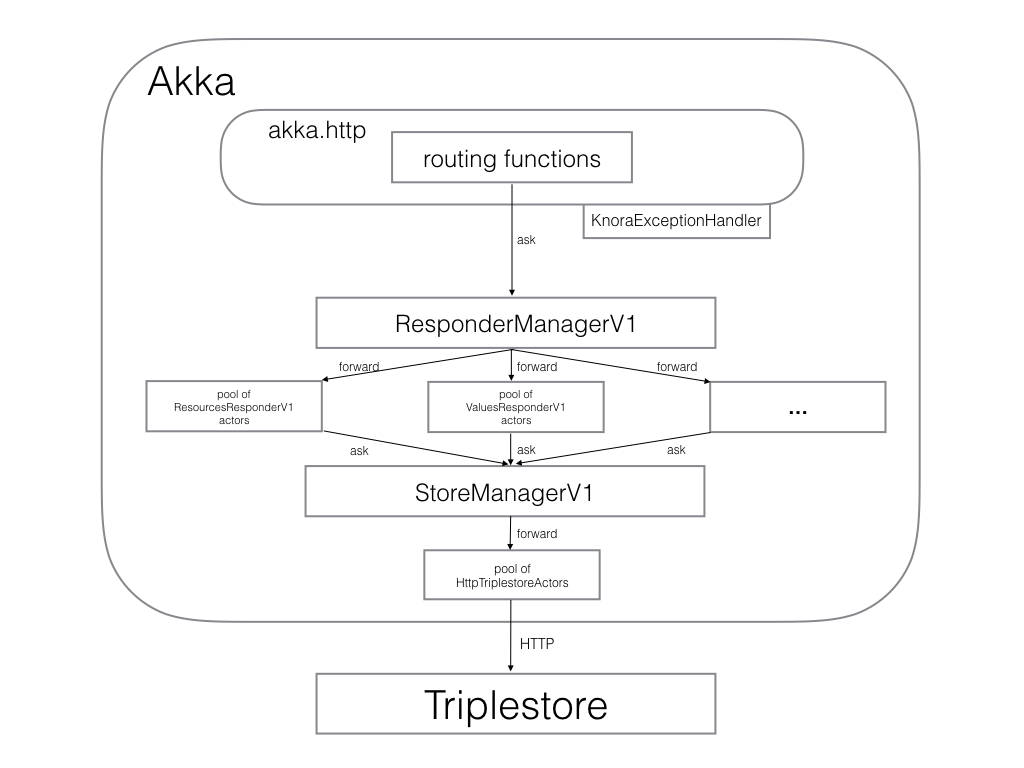
A high-level diagram of the Knora API server.
Modules
HTTP Module
- org.knora.webapi.http
- org.knora.webapi.routes
Responders Module
- org.knora.webapi.responders
Store Module
- org.knora.store
Actor Supervision and Creation
At system start, the supervisor actors are created in KnoraService.scala:
val responderManager = system.actorOf(Props(new ResponderManagerV1 with LiveActorMaker), name = "responderManager")
val storeManager = system.actorOf(Props(new StoreManager with LiveActorMaker), name = "storeManager")
Each supervisor creates and maintains a pool of workers, with an Akka
router
that dispatches messages to the workers according to some strategy. For
now, all the pools use the ‘round-robin’ strategy. The pools and routers
are configured in application.conf:
actor {
    deployment {
        user/storeManager/triplestoreRouter {
            router = round-robin-pool
            nr-of-instances = 50
        }

        user/responderManager/resourcesRouter {
            router = round-robin-pool
            nr-of-instances = 20
        }

        user/responderManager/valuesRouter {
            router = round-robin-pool
            nr-of-instances = 20
        }

        user/responderManager/representationsRouter {
            router = round-robin-pool
            nr-of-instances = 20
        }

        user/responderManager/usersRouter {
            router = round-robin-pool
            nr-of-instances = 20
        }
    }
}
Additionally, in KnoraService also the akka-http layer is started:
val host = settings.httpInterface
val port = settings.httpPort
val bindingFuture: Future[ServerBinding] = Http().bindAndHandle(Route.handlerFlow(apiRoutes), host, port)
println(s"Knora API Server started. You can access it on http://${settings.httpInterface}:${settings.httpPort}.")

bindingFuture.onFailure {
    case ex: Exception =>
    log.error(ex, s"Failed to bind to ${settings.httpInterface}:${settings.httpPort}!")
}
Concurrency
Except for a bit of caching, the Knora API server is written in a purely functional style and has no mutable state, shared or otherwise, not even within actors. This makes it easier to reason about concurrency, and eliminates an important potential source of bugs (see Out of the Tar Pit).
There is a pool of HTTP workers that handle HTTP requests concurrently
using the spray routes in the routing package. Each spray route constructs a
request message and sends it to ResponderManagerV1, which forwards it to a worker actor
in one of its pools. So the size of the HTTP worker pool sets the maximum number
of concurrent HTTP requests, and the size of the worker pool for each
responder sets the maximum number of concurrent messages for that
responder. Whenever a responder needs to do a SPARQL query, it sends a
message to the store manager, which forwards it to a triplestore actor.
The size of the pool(s) of triplestore actors sets the
maximum number of concurrent SPARQL queries.
The routes and actors in the Knora API server uses Akka’s ask pattern, rather than the tell
pattern, to send messages and receive responses, because this simplifies the code
considerably (using tell would require actors to maintain complex mutable state),
with no apparent reduction in performance.
To manage asynchronous communication between actors, the Knora API server uses Scala’s
Future monad extensively. See Futures with Akka for details.
We use Akka’s asynchronous logging interface (see Akka Logging).
What the Responders Do
In the Knora API server, a ‘responder’ is an actor that receives a request message (a
Scala case class) in the ask pattern, gets data from the
triplestore, and turns that data into a reply message (another case
class). These reply messages are are defined in the schemas package.
A responder can produce a reply representing a complete API response, or
part of a response that will be used by another responder. If it’s a
complete API response, it will extend KnoraJsonResponse, which can
be converted directly into JSON by calling its toJsValue method (see
the section on JSON below).
All messages to responders go through the responder supervisor actor
(ResponderManagerV1).
Store Module (org.knora.webapi.store package)
The Store module is used for accessing the triplestore and other external storage providers.
All access to the Store module goes through the StoreManager
supervisor actor. The StoreManager creates pools of actors, such as
HttpTriplestoreActor, that interface with the storage providers.
The contents of the store package are not used directly by other
packages, which interact with the store package only by sending
messages to StoreManager.
Generation and parsing of SPARQL are handled by this module.
See Store Module for a deeper discussion.
Triplestore Access
SPARQL queries are generated from templates, using the Twirl template engine.
For example, if we’re querying a resource, the template will contain a
placeholder for the resource’s IRI. The templates can be found under
src/main/twirl/queries/sparql/v1. So far we have been able to avoid generating
different SPARQL for different triplestores.
The org.knora.webapi.store package contains actors for communicating with triplestores in different ways: a
triplestore can be accessed over HTTP via the SPARQL 1.1 Protocol, or it can be embedded in
the Knora API server. However, a responder is not expected to know which triplestore is being used or how the
triplestore is accessed. To perform a SPARQL query, a responder sends a message to the storeManager
actor, like this:
private val storeManager = context.actorSelection("/user/storeManager")

// ...

private def getSomeValue(resourceIri: IRI): Future[String] = {
    for {
        sparqlQuery <- Future(queries.sparql.v1.txt.someTemplate(resourceIri).toString())
        queryResponse <- (storeManager ? SparqlSelectRequest(sparqlQuery)).mapTo[SparqlSelectResponse]
        someValue = // get some value from the query response
    } yield someValue
}
Error Handling
The error-handling design has these aims:
- Simplify the error-handling code in actors as much as possible.
- Produce error messages that clearly indicate the context in which the error occurred (i.e. what the application was trying to do).
- Ensure that clients receive an appropriate error message when an error occurs.
- Ensure that
askrequests are properly terminated with anakka.actor.Status.Failuremessage in the event of an error, without which they will simply time out (see Send-And-Receive-Future). - When a actor encounters an error that isn’t the client’s fault (e.g. a triplestore failure), log it, but don’t do this with errors caused by bad input.
- When logging errors, include the full JVM stack trace.
The design does not yet include, but could easily accommodate, translations of error messages into different languages.
A hierarchy of exception classes is defined in Exceptions.scala,
representing different sorts of errors that could occur. The hierarchy
has two main branches:
RequestRejectedException, an abstract class for errors that are the client’s fault. These errors are not logged.InternalServerException, an abstract class for errors that are not the client’s fault. These errors are logged.
Exception classes in this hierarchy can be defined to include a wrapped
cause exception. When an exception is logged, its stack trace will
be logged along with the stack trace of its cause. It is therefore
recommended that low-level code should catch low-level exceptions, and
wrap them in one of our higher-level exceptions, in order to clarify the
context in which the error occurred.
To simplify error-handling in responders, a utility method called future2Message is provided
in ActorUtils. It is intended to be used in an actor’s receive method to respond to
messages in the ask pattern. If the responder’s computation is successful,
it is sent to the requesting actor as a response to the ask. If the
computation fails, the exception representing the failure is wrapped in
a Status.Failure, which is sent as a response to the ask. If the
error is a subclass of RequestRejectedException, only the sender is
notified of the error; otherwise, the error is also logged and rethrown
(so that the KnoraExceptionHandler can handle the exception).
In many cases, we transform data from the triplestore into a Map
object. To simplify checking for required values in these collections,
the class ErrorHandlingMap is provided. You can wrap any Map in
an ErrorHandlingMap. You must provide a function that will generate an error message
when a required value is missing, and
optionally a function that throws a particular exception. Rows of SPARQL
query results are already returned in ErrorHandlingMap objects.
If you want to add a new exception class, see the comments in
Exceptions.scala for instructions.
Transformation of Exception to Client Responses
The org.knora.webapi.KnoraExceptionHandler is brought implicitly into scope of akka-http,
and by doing so registered and used to handle the transformation of all KnoraExceptions into HttpResponses. This
handler handles only exceptions thrown inside the route and not the actors. However, the design of reply message passing
from actors (by using future2Message), makes sure that any exceptions thrown inside actors, will reach the route,
where they will be handled.
See also Futures with Akka.
API Routing
The API routes in the routing package are defined using the DSL
provided by the akka-http library. A routing function has to do the following:
- Authenticate the client.
- Figure out what the client is asking for.
- Construct an appropriate request message and send it to
ResponderManagerV1, using theaskpattern. - Return a result to the client.
To simplify the coding of routing functions, they are contained in objects that extend
org.knora.webapi.routing.Authenticator. Each routing function performs the following operations:
Authenticator.getUserProfileV1is called to authenticate the user.- The request parameters are interpreted and validated, and a request message is constructed to send to the responder.
If the request is invalid,
BadRequestExceptionis thrown. If the request message is requesting an update operation, it must include a UUID generated byUUID.randomUUID, so the responder can obtain a write lock on the resource being updated.
The routing function then passes the message to org.knora.webapi.routing.RouteUtils.runJsonRoute(), which takes
care of sending the message to ResponderManagerV1 and returning a response to the client. Any exceptions thrown
befor calling org.knora.webapi.routing.RouteUtils.runJsonRoute() are handled by the KnoraExceptionHandler.
See How to Add an API Route for an example.
JSON
The Knora API server parses and generate JSON using the spray-json library.
The triplestore returns results in JSON, and these are parsed into SparqlSelectResponse objects in the store
package (by SparqlUtils, which can be used by any actor in that package). A SparqlSelectResponse has a
structure that’s very close to the JSON returned by a triplestore via the SPARQL 1.1 Protocol:
it contains a header (listing the variables that were used in the query) and a body (containing rows of query
results). Each row of query results is represented by a VariableResultsRow, which contains a Map[String, String]
of variable names to values.
The Jsonable trait marks classes that can convert themselves into
spray-json AST objects when you call their toJsValue method; it
returns a JsValue object, which can then be converted to text by
calling its prettyPrint or compactPrint methods. Case classes
representing complete API responses extend the KnoraResponseV1
trait, which extends Jsonable. Case classes representing Knora
values extend the ApiValueV1 trait, which also extends Jsonable. To
make the responders reusable, the JSON for API responses is generated
only at the last moment, by the RouteUtils.runJsonRoute() function.